Wednesday, September 21, 2022

A Rhoads Saga

 This blog was established to present the history of the Imles. But interesting tales sometimes require a detour to other connections. One of those detours involves the Rhoads family, which was a major focus in our last blog. If you remember, the Revolutionary veteran Daniel Rhoads had a great great granddaughter Olive Geisert, who married my grandfather Adam Imle. And Daniel had a great great grandson Lawrence Willington Rhoads, who married Bessie Maude Hanks, a relative of Abraham Lincoln’s mother. Except, as we saw in the previous blog, she wasn’t.

Daniel Rhoads had other interesting descendants, one of them his son Thomas Rhoads.

Thomas Rhoads

In 1835, while living in Edgar County, Illinois, Thomas Rhoads converted to the Latter Day  Saints Church. In May 1846, Thomas, his wife (Elizabeth Foster), a multitude of his children, and other Saints started out to help look for spots for Mormon pioneers. This was a year before Brigham Young left Nebraska on his trek to Utah, and was the month and year that the Donner Party headed west from Independence, Missouri. Thomas and his fellow travelers bypassed the Salt Lake, traveling all the way to California and arriving in October. They made the journey without mishap. The Donner Party, which was delayed by only a few weeks, did not.

Thomas and his eldest son John were called on to help rescue the Donner party travelers. John headed the first Donner relief expedition, an adventure worthy of much more than a blog.

Thomas settled in the Sacramento Valley and was reportedly working for John Sutter in January 1848 when gold was discovered on Sutter's property. Thomas and other saints were called to come to Salt Lake City and Thomas obeyed, leaving California in August, 1849. Thus, Thomas Rhoads returned in a direction opposite that being taken by the "Forty Niners."

Though Thomas did not participate in the California gold rush, he reportedly arrived in Salt Lake City a rich man. He acquired a fine home and, it is claimed, seven more wives. He is believed to have significantly helped finance the Deseret Mint.

In later years Thomas and his son Caleb were said to have obtained large amounts of Indian gold from abandoned Spanish gold mines in the Uinta Mountains. Apparently, Thomas, and later Caleb, were assigned to collect gold from a Ute war chief, Wakara (called "Walker" by white men), who had been converted to the LDS Church. Whether true or not, the rumor has been the basis of many prospecting trips and a number of books, including one coauthored by Thomas's great great grandson Gale R. Rhoades (his line adds an "e"), Footprints in the Wilderness. The prices of Rhoads mines books have skyrocketed due to buyers hoping to discover the mines. A well-used paperback copy of Footprints cost me $140, and my only interest was history, not fortune. Even though I was Gale's fourth cousin, once removed, I received no discount.

Friday, January 8, 2021

A Lincoln Connection?

 In the Ogden Cemetery, near Paris in Edgar Co, Illinois, and just a few miles north of Marshall, are markers for several members of the Rhoads family, ancestors of Olive Geisert, wife of Adam Imle. In the cemetery lie Olive’s great great grandfather, Daniel Rhoads, a veteran of the Revolutionary War. Her great great grandmother Elizabeth (Newman) Rhoads. Her great great uncle Newman Rhoads. Her cousins (first, second, third, and otherwise) Willington, Benjamin Tolbert, Daniel, Benjamin Rhoads. And also in Ogden Cemetery is a marker for Sarah (Hanks) Varrell, whose great granddaughter is believed to be Bessie Maude Hanks, who married Lawrence Willington Rhoads, Olive’s third cousin. Now that would not be anything special except that Sarah’s marker is inscribed 

SARAH HANKS
VARRELL
1786 - 1876
AUNT OF
ABRAHAM LINCOLN

 So, do we relatives of Adam and Olive Imle have a connection with Lincoln, our sixteenth president? Disappointingly, we don’t. Though Nancy Hanks, mother of Abraham Lincoln, did have a sister Sarah, the two Sarahs are not the same. The Sarah Hanks buried in Ogden was probably a daughter of Abraham and Sarah (Harper) Hanks and not of Lucy Hanks, Abraham Lincoln’s grandmother.

 The grave marker clearly states that Sarah was Abraham Lincoln’s Aunt. But on the marker is a plaque inscribed “DAUGHTERS OF THE AMERICAN REVOLUTION.” The marker proclaiming the Lincoln relationship was erected by the DAR long after Sarah’s death, and we all know how reliable the DAR is. Often, not very. For more information on the extremely murky genealogy of Nancy Hanks, mother of Abraham Lincoln, I recommend Nancy Hanks, of Undistinguished Families, published 1959 by Adin Baber. You can see a free copy on Internet Archive. (As a side note: Adin Baber’s first cousin, three times removed, David Baber, married Elizabeth Tapscott, my third cousin, four times removed. This, of course, has absolutely nothing to do with the Hanks or Rhoads family.)

Me with Sarah’s replaced marker, back 
when I thought I was connected (2003).

Sarah’s original marker (Find A Grave).


Saturday, January 2, 2021

Wanted, Imle and Geisert Photo Detectives


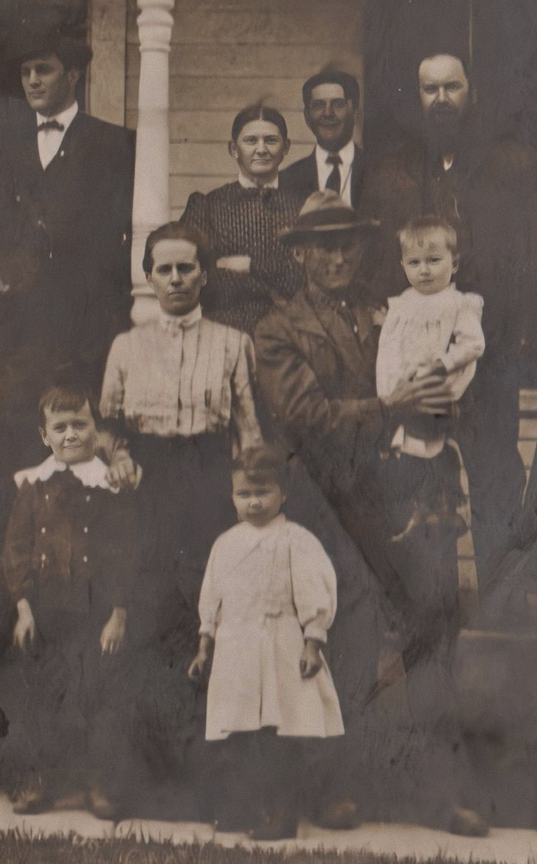
I’m looking for help from Imles and from Clark Co, Illinois, Geiserts. In 2003 I purchased a photo from a finder of lost photos in Vincennes, Indiana. He had purchased the photo from an antiques store in Terre Haute, Indiana. A very faint inscription in very large handwriting on the back read “Gottlob Imle.” It is likely that this photo belonged at one time to Gottleib (usual spelling) William Imle, son of Christoph Imle of Clark Co Illinois, and was scrapped, sold, or given away. Most of Gottleib’s adult life was living in Terre Haute. Here is a copy of the original photo, followed by an enhanced (MyHeritage) and edited (me) copy to give a sharpened version.


The following identifications are certain or nearly so: Comparison with other photos shows that this photo was taken in front of what was called the “big house,” where my great grandparents Christoph Frederick and Anna Maria (Reichert) Imle lived around the turn of the last century. In later years it became the property of Christoph and Anna’s son Christian Karl Imle (my uncle Chris), and the porch was eventually removed. In the exact center of the picture are my grandparents Olive Rachel Geisert and Adam Conrad Imle, both easily (to me) recognizable. Since they are in the middle of the photo, have no children with them, and Olive appears to be wearing a dress identical to that in her wedding photo, this picture was likely taken on or near their wedding day, 7 Mar 1906. Immediately behind Olive Geisert is her sister Minnie Geisert, who is easily recognizable. At the right of the photo standing on the porch are Anna Maria Reichert (just right of the porch support, with her hair parted exactly down the center) and to her left Christoph Frederick Imle (bulky man with a black beard).

From now on much is guesswork based on other photos and ages and sexes of children. The woman, man, and three children to the right of Olive and Adam could be the Frederick (Fred) Christian and Clara (Coldren) Imle family, who had three children in 1906—7-year old John, 5-year old Susan, and 2-year old Edgar. The woman strongly resembles Clara though the man lacks the mustache seen in some photos of Fred Imle. The man in the large hat and the woman standing at the back on the porch on the left are probably Edward Geisert and his wife, Maria Emmeline Rhoads. The couple is of the right age, the man sports a mustache as did Edward, and the woman bears a very strong resemblance to Maria seen in other photos. The couple to the far left with an infant are probably Gottlieb and Clara (Schroeder) Imle. Both (particularly the woman) bear strong resemblances to Gottlieb and Clara in other photos and, at the date of Adam and Olive’s wedding, they had a single child, Irma, a 7-month old infant. The man standing behind Anna Maria and Christoph strongly resembles Chris Imle.

Perhaps you descendants of Christoph and Anna Maria Imle and/or of Edward and Maria (Rhoads) can confirm some of this. Or, better yet, can identify others. The old man with the white beard at the far right is particularly mysterious. He appears to be of an earlier generation.

Below are four enlarged segments of the photo from left to right. Like a jpg image of the original and enhanced/edited photos? Email me at  retapscott@comcast.net.


Monday, August 26, 2019

An Anarchist in the Family


A few days ago, on 23 Aug, I received an email from Herr Ulrich D. Oppitz, who has published a biography of Fanny Lili Imle in Biographisch-Bibliographisches Kirchenlexikon (2019, pp. 529-564). Knowing of my Imle blog, Herr Oppitz sent me a copy of his article, and introduced me to an “oh so interesting Imle,” who I had not previously encountered. Fanny seems to be big news these days. Another Ulrich, the American-German historian Ulrich L. Lehner, has also been investigating Fanny's life. Before reporting on the life of Fanny Imle, I must warn my readership of two things. First nearly all that follows comes from sources other than myself. I have done relatively little family history research on Imles outside the U.S. Second, nearly all those sources were written in German, and my knowledge of the German language leaves much to be desired.

Born on 2 Apr 1878 in Ellwangen an der Jangst in Germany to Hugo Karl Emil Gottlieb Imle and his second wife, Fanny Keller, Fanny Imle never married. She is, however, said to have had an illegitimate son, Walter, born 4 Aug 1900.  The record of Walter's death gives his mother as "unverehelichte Lilli Imle, wonhaft in Paderborn" (unmarried Lilli Imle, resident of Paderborn). Fanny's middle name was "Lili" and she was known to have lived primarily in Paderborn beginning as early as 1940. Like his grandfather Hugo, Walter served in the military, dying in Belgorod, Russia, during WW II on 22 May 1942.
Fanny Imle was a champion for women's rights, an economist, a philosopher, and a lay preacher, who dared to assert herself in male domains. In 1897 she began studying philosophy at the University of Zurich, one of the few German colleges that admitted women. At the time, Zurich was a gathering point for advocates of radical liberalism, women's emancipation, and socialist ideas. She received her doctorate on 5 March 1907 from the Faculty of Law and Political Science at the University of Freiburg.

Fanny Imle often appeared at the public debates and made political speeches. Around 1900, she was very active in the German anarchist movement, publishing articles in anarchist newspapers, but then moved to Social Democracy. After 1904, when she converted to Catholicism, Fanny became involved in the Christian labor movement, writing many articles on working life. In 1907 she obtained a doctorate, and in 1912, became a Franciscan Nun. And she did all this while nearly blind.


One of Fanny’s first books was her 1907 text on labor unions, Die Tarifvertrage zwischen Arbeitgebern und Arbeitnehmern in Deutschland (Collective Agreements Between Employers and Employees in Germany). In 1920 she published Die Frau in der Politik (The Woman in Politics), in which she declared “Gruß den Frauen, Sie flechten und weben / himmlische Werte ins politische Leben” (“Greetings to women, they weave and weave / divine values into political life”). But the book was not what one might expect. By that time, following her conversion to Catholicism, Fanny was fighting against moral decline, arguing for a return to traditional, religiously based norms. She declared that

“Since [August] Bebel attempted, in his book Woman to irrevocably link woman and revolution, millions of misled fellow citizens have been certain that revolutionary violence will free the female sex, and that free woman would do away with the last remnants of bourgeois order, legality, morality, and religion.”

This from a one-time anarchist!

Her change is documented. At the beginning of 1918, the former anarchist Rudolf Rocker (1878-1958) returned from internment in England to Germany and was, until his fate was clarified, imprisoned in in Goch (Lower Rhine). A head nurse in charge there gave him a stack of books, among which were the writings of Fanny Imle. Rocker had met Imle in London and was amazed at the writing. The nurse now told him,

“That was probably during her revolutionary period when she was an anarchist. Oh, she's been through a big change since then. She's a wonderful woman, we're all excited about her. Although she is completely blind, she gives lectures week after week. She now lives in a monastery in Munich.”

In later years Fanny wrote such philosophical tomes as Friedrich von Schlegels entwicklung von Kant zum Katholizimus (Friedrich von Schlegel's development from Kant to Catholicism, 1927), Novalis; Seine Philosophische Weltanschauung (Novalis; His Philosophical Worldview, 1928), and Die Theologie des hl. Bonaventura (The theology of St. Bonaventura, 1934).

Following WWII Fanny lived most of her life in the North Rhine-Westphalian city of Paderborn, where many of her books were published and which was 85 percent destroyed during WW II. She died 11 Aug 1965 in Niedermarsberg, and was buried in Paderborn’s Westfriedhof cemetery. It is claimed, however, that in 1997 the grave was "leveled" ("eingeebnet"), whatever that may mean. Fanny's name is not found today among Westfriedhof burials.

Much about Fanny’s life is still unknown. In particular, it is claimed that she wrote her memoirs, which detailed the destruction of Paderborn during WWII, and which appear to have been lost.

Was Fanny part of our Imle family? Yes, according to other researchers. But one must go back a long way to find the connection. All the way back to Hans Joachim (1560-1635) and Katharine (Luthardt) Imle (1565-1635), who were the 7G grandparents of both Christopher Frederick Imle (my great grandfather) and Fanny Lili Imle.


Friday, February 15, 2019

Imles Under the Skin


Lines of Christoph Frederick
and Johannes Saul
In the United States all (or nearly all) individuals with the surname “Imle” appear to be descended from Christoph Frederick and Anna Maria (Reichert) Imle, who arrived in the U.S. from Gundelbach, Germany, 15 Apr 1881.

But there are believed to be other U.S. “Imles” with a different surname spelling (see blog of 16 Dec 2015, “What's in a name?”). One family tree shows that on 17 Dec 1812 in Gundelbach was born Johannes Saul Imle, shown by another tree to be the third cousin once removed of our Christoph Frederick. Sometime in the early 1800s Johannes immigrated to the United States (beating Christoph’s arrival by several decades), was married 20 Sep 1835 in Ohio, and settled in Indiana, where he died on 14 Mar 1896. Johannes anglicized his name to “John” with, at various times, surnames  of “Emly,” “Emley,” and “Emily.” (Similar to the German pronunciation of "Imle.") Most of his descendants settled on the name “Emily” though the name “Emly” is also seen.

Gundelbach, birthplace of Christoph
 Frederick Imle & Johannes Saul Imle.
We now have additional evidence supporting this history. Two GG grandsons of Johannes Saul Imle have been in contact with me. The two U.S. first cousins, an “Emily” and an “Emly,” are calculated from still questionable family trees to be my 7th cousins. Autosomal DNA testing now predicts that my Emly cousin and I are 5th to 8th cousins. Thus DNA results give credence to our family trees and show that at least some U.S. Emilys and Emlys are really Imles under the skin.

DNA testing is poor at determining that one's grandfather was a blue-eyed fisherman from Ireland, as suggested in some advertisements, or that one should exchange lederhosen for kilts, as claimed in others. But it can be excellent for confirming relationships and boosting the reliability of family trees. Welcome aboard Emilys and Emlys.


Thursday, May 17, 2018

John Imle Sr., Log Cabins


Page 1 of  John's Journal

Among records collected while researching the Imles are seven digital pages of an incomplete manuscript entitled “John Frederick Imle Sr., Journal.” John Sr. was the son of Frederick Christian and Clara Josephine (Coldren) Imle. An accompanying note states that the record was given me by John Imle Jr., though I don’t remember this. Anyway, thank you John.

My questionable transcription of the exceedingly unclear electronic copy is presented in three parts, here and in the following two blogs. My own comments (primarily the word “unclear”) are shown in brackets.


I was born “at an early age” on or about 1899 just 30 days before the 20th century. The place: a little log cabin one-half mile or so north of the “metropolis” of Ernst, Darwin Township, Clark County, Illinois. Ernst was a flagstop on the Cleveland, Cincinnati, Chicago and Cairo railroad (the big four as it was then known) which ran between Chicago and Cairo mainly hauling coal from the southern Illinois coal fields to the industrial area around Chicago. Ernst was named (reputedly) after one Ernst Ruhl* a Former land surveyor who laid out and reportedly acquired large land holdings in its immediate area while it was still Northwest Territory and before Illinois became a state in 1808.
The log cabin of my birth was located on the land purchased by grandfather Imle when he immigrated from Germany in early 1881 with grandmother and six children Mary, [unclear] my father, Christian, Gotlieb, Arthur [?] & Adam. My father was 9 and Adam the youngest was just [unclear] year old. Who built the cabin and who previously owned the land [several lines unclear] that they are all gone!! They would have made an interesting study.
[Unclear line] It was later owned by Uncle Chris Imle and still later by Uncle Billy (Wilhelm) Imle who acquired it in [unclear] from granddad when they married. I was often reminded by my mother of the fact that I had something in common with Abe Lincoln – born in a log cabin! That occurred when dad and mother lived there in their early marriage days – 1898 to some time in 1900 [?]. Grandad and family had by then moved to a new frame house build northward of Ernst sometime in the middle 90’s.
In our [unclear] area and north [unclear] Marshall, I can recall at least five log houses that were still occupied most [rest of paragraph unclear except for scattered words]

*Ruhl was the first recorded owner of our farm ½ mile N of Ernst and on which I lived from 1902 to 1919. Later: Examination of Clerk’s records by Ed & Ernest in 1980 found the more recent owner to have been one York [?].

Tuesday, February 6, 2018

Portia

A few days ago, my second cousin Elizabeth (Liz) Smith emailed relatives telling us of the 2 Feb 2018 death of Portia Mary (Mollard) Imle, widow of Ernest Paul Imle Sr. The internet obituary (http://www.borgwardtfuneralhome.com/notices/Portia-Imle) tells a lot about Portia's life—her interest in anthroposophy (look it up), her travels, her scholarly activities, the tragic death of her son. [While bicycling, Bill was killed by a drunk driver, who had killed another bicyclist two years earlier.] But her marriage to “Ernesto” is worthy of a few more details, details that Portia provided me by telephone a few years ago.


El Buen Pastor Anglican Church, San Jose
Following the death by cancer of her stepmother, Olga, Portia traveled to Puerto Rico, where she met Ernest. In that country Ernest was known as “Don Ernesto” to friends and colleagues and Portia called him “Ernesto” throughout their lives together. After she returned home Ernesto was sent to the Beltsville Agriculture Research Center of the USDA, where they continued to see each other. In 1947 they were married in Costa Rica, a location selected because it was the home of most of their close friends. In Costa Rica a marriage in a Catholic Church would have simultaneously given them a civil marriage, but since they were married in an Anglican Church, they had to also be married in a Civil Ceremony. Thus, they had marriage dates of both 24 November (church) and 27 November (civil), which was Thanksgiving. Throughout their married lives, Ernesto and Portia celebrated their anniversary on Thanksgiving, regardless of the date on which it fell. They were married on the 27th by the mayor of San Jose. There were insufficient people at the civil ceremony to provide the necessary witnesses. From off the street, they pulled in two people, neither of whom could write, to act as witnesses. The witnesses signed the document with a mark.