Showing posts with label Gottlieb William Imle. Show all posts

Saturday, January 2, 2021

Wanted, Imle and Geisert Photo Detectives


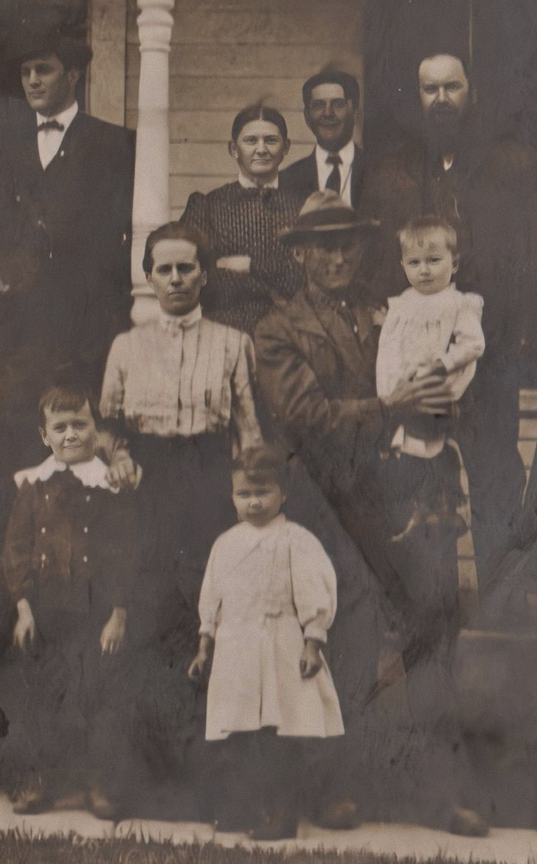
I’m looking for help from Imles and from Clark Co, Illinois, Geiserts. In 2003 I purchased a photo from a finder of lost photos in Vincennes, Indiana. He had purchased the photo from an antiques store in Terre Haute, Indiana. A very faint inscription in very large handwriting on the back read “Gottlob Imle.” It is likely that this photo belonged at one time to Gottleib (usual spelling) William Imle, son of Christoph Imle of Clark Co Illinois, and was scrapped, sold, or given away. Most of Gottleib’s adult life was living in Terre Haute. Here is a copy of the original photo, followed by an enhanced (MyHeritage) and edited (me) copy to give a sharpened version.


The following identifications are certain or nearly so: Comparison with other photos shows that this photo was taken in front of what was called the “big house,” where my great grandparents Christoph Frederick and Anna Maria (Reichert) Imle lived around the turn of the last century. In later years it became the property of Christoph and Anna’s son Christian Karl Imle (my uncle Chris), and the porch was eventually removed. In the exact center of the picture are my grandparents Olive Rachel Geisert and Adam Conrad Imle, both easily (to me) recognizable. Since they are in the middle of the photo, have no children with them, and Olive appears to be wearing a dress identical to that in her wedding photo, this picture was likely taken on or near their wedding day, 7 Mar 1906. Immediately behind Olive Geisert is her sister Minnie Geisert, who is easily recognizable. At the right of the photo standing on the porch are Anna Maria Reichert (just right of the porch support, with her hair parted exactly down the center) and to her left Christoph Frederick Imle (bulky man with a black beard).

From now on much is guesswork based on other photos and ages and sexes of children. The woman, man, and three children to the right of Olive and Adam could be the Frederick (Fred) Christian and Clara (Coldren) Imle family, who had three children in 1906—7-year old John, 5-year old Susan, and 2-year old Edgar. The woman strongly resembles Clara though the man lacks the mustache seen in some photos of Fred Imle. The man in the large hat and the woman standing at the back on the porch on the left are probably Edward Geisert and his wife, Maria Emmeline Rhoads. The couple is of the right age, the man sports a mustache as did Edward, and the woman bears a very strong resemblance to Maria seen in other photos. The couple to the far left with an infant are probably Gottlieb and Clara (Schroeder) Imle. Both (particularly the woman) bear strong resemblances to Gottlieb and Clara in other photos and, at the date of Adam and Olive’s wedding, they had a single child, Irma, a 7-month old infant. The man standing behind Anna Maria and Christoph strongly resembles Chris Imle.

Perhaps you descendants of Christoph and Anna Maria Imle and/or of Edward and Maria (Rhoads) can confirm some of this. Or, better yet, can identify others. The old man with the white beard at the far right is particularly mysterious. He appears to be of an earlier generation.

Below are four enlarged segments of the photo from left to right. Like a jpg image of the original and enhanced/edited photos? Email me at  retapscott@comcast.net.


Monday, November 23, 2015

The Immigrants


In 1874, the SS W. A Scholten was put into service by the Netherlands American Steamship Company (later, the Holland-America Line) for regular mail and passenger service between Rotterdam and New York. The ship was a three-masted steamer, capable of traveling at 40 knots and carrying about 700 steerage passengers and 50 first and second-class passengers. The Scholten boasted the most modern conveniences—compartmentalized steerage, providing a little privacy, and two hospital wards, one for men and one for women.

For thirteen years, the Scholten transported (primarily) German emigrants to America. Then, on 19 Nov 1887, the ship left Rotterdam, heading for New York with 230 passengers and crew. At 11 pm that night, in a dense fog, the ship struck the English steamer Rosa Maria, ten miles off Dover. The Scholten sank within an hour with the loss of 150 lives. Many of the dead were German. No lives were lost on the Rosa Maria.

Six years earlier, the SS Scholten had sailed from Rotterdam, docking in New York on 15 Apr 1881. (16 Apr 1881, the date that the passenger list was signed, is often given as the arrival date; however, newspaper articles show that Apr 15 was the actual date.) Among the 707 passengers were a family of seven from Gündelbach, Frederick and Marie Imle and their five children (at that time), Marie, Fredrick, Christian, Gotllieb, and Adam. Had they been part of the 1887 voyage, this posting would likely not exist, nor would we.

 Imles on list of passengers docking in New York City, 16 Apr 1881 on the SS W. A. Scholten.

Sunday, November 15, 2015

Ein Imle Familie Geschichte


I’m back on track with the Imle book, although I am trying to write two books simultaneously (the other on the Tapscotts of Clark County). I hope this works out. Tentatively the Imle book will be titled It Started in Gündelbach, Ein Imle Familie Geschichte—probably far too long, but C’est la vie (or should it be So ist das Leben?).

In 1881, Frederick and Anna Marie Imle lived in Gündelbach, Württemberg, Germany with their five children Maria, Fred, Chris, Adam, and Gottlieb, where they managed vinyards. Not wishing their sons to be drafted into the compulsory German Army they decided to move to America, with the Adam Pantle family as sponsors. (Pantle descendants still live in Marshall and Paris.) The Imle family left Rotterdam, Holland on 26 Mar 1881, landed on in New York on 15 Apr 1881, and made their way west to settle on a farm a few miles south of Marshall.

Frederick bought the farm and he and his sons spent their time tending crops, while Maria tended children, house, and gardens. In time, four more children—Bertha, Anna, William, and Herman—were added to the family.

No one knows for certain how many descendants there are from the nine children. Attending a reunion in honor of the 100th anniversary of the arrival of the Imles in the United States were 150 people from a dozen states. A recent count from my incomplete database shows 304 descendants plus 176 spouses.

Imle Family Reunion, 12 Jul 1981, Lincoln Trail State Park, Clark County, Illinois.
 My interest in family history was sparked by my mother’s passing around Christmas, 2000, but it was encouragement from Dorothea Maria (Imle) Dunlap, “Dottie Rose,” my mother’s cousin, that that got me going on the Imles. Dottie Rose and several other Imles (in particular, Edgar, author of a magnus opus), had already written large portions of Imle family history. I was asked only to expand their work.

The expansion has turned out to be much more difficult than I had envisioned. First, it has taken on a life of its own to include Imle relatives, history, and geography. Second, Imle descendants have increased geometrically, possibly exponentially. Third, Imles have spread across the United States and outside the country. For over 300 years, the Imles had lived in the same small region of Germany, most of this time in the same town, much of that time in the same house. Then, for 40 years or so after arriving, most remained in and around Clark County. But then the small dispersion became a diaspora and since the 1981 reunion a DIASPORA! The reason is affluence. H. B. Guppy (Homes of Family Names in Great Britain) wrote a passage about the dispersion of affluent Englishmen. It applies equally well to Germans:

“It was the boast of a wealthy old Devonshire yeoman, 150 years ago, that he had never crossed the borders of his native county, and I cannot believe that in this respect he differed greatly from his fellows. From the stationary conditions of their lives, and from the nature of their pursuits and surroundings, they acquired a solid mediocrity of character, to which the long persistence of families in the same locality and in the same station is mainly due. England, in truth, owes much to their lack of aspiration and to their home-loving ways. It is, however, remarkable that the rise of a family into a condition of opulence is, as a rule, shortly followed by its dispersal, until within a generation or two, the home of the name for centuries knows it no more.”


Tracking down the multiplied and dispersed descendants has proven almost, but not quite impossible. These postings will describe this venture and what I find along the way.

All genealogical data are from primary or reputable secondary sources and never from unsourced online trees. Contact the author to request sources, omitted here to improve readability. Readers may use any posted material for any purpose as long as this source is cited. Most important, I need your help. Please tell me of errors, suggested additions, and photos you can contribute. I need your criticisms, comments, complaints.